
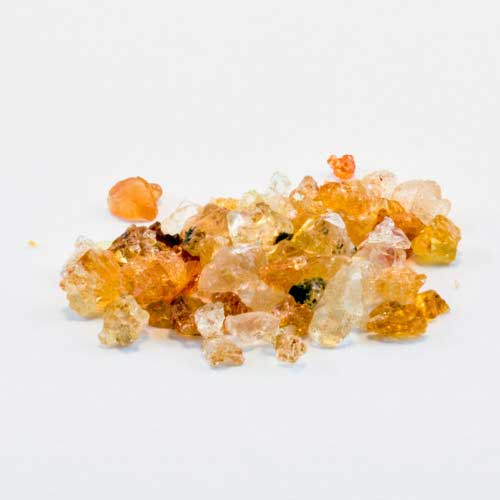
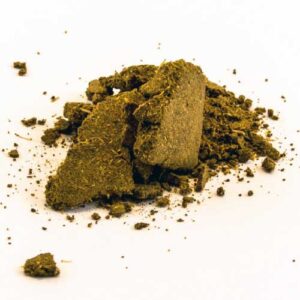
The Acacia tree grows in a region that stretches from Senegal to Sudan in Africa and cultivated in Arabia and West Asia. Gum arabic, a complex mixture of polysaccharides and glycoproteins, is used primarily in the food industry as a stabilizer.
On trees of the genus Acacia that exude gums, the harvest is described as follows:
“The gum harvest from the various species lasts about five weeks. About the middle of November, after the rainy season, it exudes spontaneously from the trunk and principal branches, but the flow is generally stimulated by incisions in the bark, a thin strip, 2 to 3 feet in length and 1 to 3 inches wide being torn off. In about fifteen days it thickens in the furrow down which it runs, hardening on exposure to the air, usually in the form of round or oval tears, about the size of a pigeon’s egg, but sometimes in vermicular forms, white or red, according to whether the species is a white or red gum tree.
About the middle of December, the Moors commence the harvesting. The masses of gum are collected, either while adhering to the bark, or after it falls to the ground, the entire product, often of various species, thus collected, is packed in baskets and very large sacks of tanned leather and brought on camels and bullocks to the centres of accumulation and then to the points of export, chiefly Suakin, Alexandria, or – in Senegambia – St. Louis. It is then known as ‘Acacia sorts,’ the term being equivalent to ‘unassorted Acacia.’ The unsorted gums show the widest variation as to size of fragments, whiteness, clearness, freedom from adhering matter, etc. It is next sorted or ‘picked’ in accordance with these differences.”
Source: Greives M. A Modern Herbal. New York, NY: Penguin Books, 1980.
Reviews
There are no reviews yet.